Folks, this is just gross

Within the span of five days, the same story, from two different publications, came before me. It appears that a test tube burger has been created. Folks, this is just gross. The meat, described as grey and slippery in texture, has been grown from the stem cells of a cow and minced together with “lab-grown animal fat” to form the burger. Because the article mentions attempts at making mouse burger, I’m wondering where that animal fat is coming from. So, just what qualities does this burger have? Not taste or nutrition. One article goes on to say that “it is possible to add fatty tissue and nutrients to it, changing the taste and making it more palatable”. In other words, the meat being grown isn’t nutritious and tastes bad therefore it requires more processing. Will these nutrients also be grown in test tubes? Sarcasm implied. What’s more, is that the mostly unspecified materials used to produce future cell-grown burgers will be replaced by materials “not originating from animals”. What will these replacement materials be? Plants? Man-made substances?

The idea behind this is to feed a growing population and keep the cost of meat down. One question I have is, does the growing population really want more cheap, processed, un-nutritions food? I believe we already have it in the refrigerated meat isle and it comes in bun length.

I have a confession

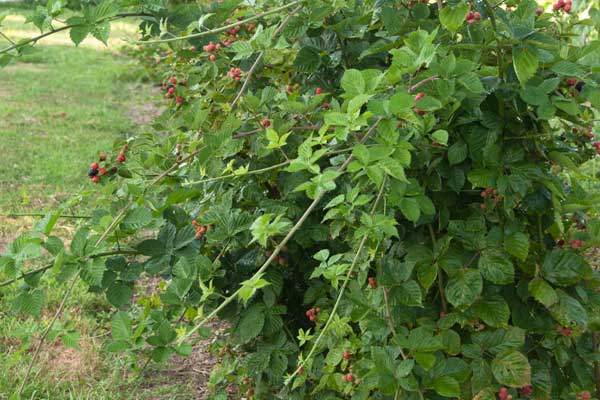
DSC_5208bgI have a confession to make. My skills are lacking when it comes to pruning and training our blackberry plants. It seems that the brambles grow faster and faster each year. I usually end up bending them around in large loops and tying them to the trellis. You know what? Now that I have voiced my burden, I have been inspired. I will square off my shoulders, walk out to the garden and pick myself some sweet, ripe berries. After all, does it really matter if the plants aren’t perfectly manicured? It’s the end result that matters.

I do have one useful tip for training blackberry plants along a trellis though. Don’t purchase string, save the string from dog food, cat food and mineral bags instead.

Baling the yard

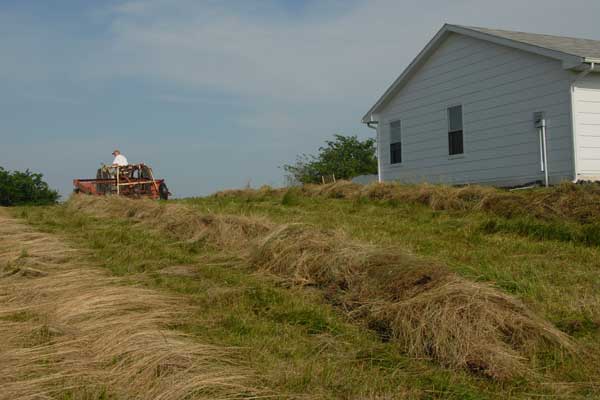
DSC_5035fbMost folks mow their lawns to make attractive landscaping for their home. Don, however, mowed ours with the intent of raking and baling the grass. Our yard area is roughly two acres and looks really nice when mowed to an even height, however about five years ago when gas prices hit $4.00 a gallon, we stopped mowing and starting grazing. My first thought was to get a couple of sheep to graze the area in lieu of mowing. The sheep would then be butchered in the fall along with hogs. This idea required the purchase of some type of fencing though. Either woven or multiple strands of electrified wire would be needed for a perimeter. We had reels of poly wire on hand but I didn’t want to use them all to fence in a couple of sheep. Instead, a single poly wire was set up as a perimeter, the yard was sectioned off and the cattle were turned in. For the last five years, the cattle have trampled and fertilized this area making a it good candidate for some square bales. What on-farm resources have you tapped and cut down costs for your efforts?

Parasite Control

We were recently contacted by an upstate South Carolina rancher about our use of Ecto-phyte and Neem oil for external parasite control. He asked what type of oil we mix with the Ecto-phyte and water, do we mix Neem oil and Ecto-phyte together, do we rotate the use of these topicals, is Neem used exclusively for lice and mite control and what mixing ratio do we use for the Neem oil spray.

My answers to him were as follows. We dissolved all natural liquid soap flakes in water and added it to the Ecto-phyte mix. Most of the time though, Don just shook the spray canister as he sprayed the cattle. We did mix the Neem oil and Ecto-phyte a few times, however now we just use the Neem for lice. If we notice a cow has hair loss due to lice, we put Neem on a disposable cloth and rub it on the affected area. This clears up the problem very quickly. We did rotate the use of these topicals, however we rarely use either now. Instead, we rely on our salt mix. As mentioned above, Neem oil is occasionally used for lice, however we did use it for flies as well by putting it on a cloth and making a swipe down the face. I couldn’t remember the mixing ratio of the Neem spray since we now douse a cloth straight out of the jug and apply it, however if we used it more often, we would mix it with water to make the oil last longer.

Now days, we mostly rely on our salt and mineral mixes for external and internal parasite control in conjunction with rotational grazing. The above topicals work until the animal sweats it off or it rains. I believe that the cattle do need access to the salt mix all the time for it to be effective though.

This rancher also asked about our mineral mix. He was adding diatomaceous earth to his mineral mix but was concerned that it would harm dung beetles, dung feeders and the fly predators that he applies to the manure piles so he asked about our experience adding diatomaceous earth to our salt mix. He also asked what role garlic powder played in our parasite control and how vinegar was administered in the mineral mix.

We use a custom salt mix that includes diatomaceous earth. Every once in a while, I scrape the top off of a manure pile and see that there are beetles/feeders in it. We seem to only have one type of dung beetle in the pasture, the dweller. The garlic is for external parasites and the sulfur of the garlic is secreted through the skin and eye fluids. The vinegar is in powder form, however I have heard from other producers that they pour vinegar directly in water tanks over a series of days.

Is this rancher’s concern about using diatomaceous earth in salt or mineral mixes unfounded? Diatomaceous earth is the fossilized remains of diatom shells. These shells are crushed and result in an abrasive, fine dust. Apparently this fine, abrasive dust pierces the bodies of internal parasites which makes them dehydrate and die. The concern is what does the dust do to the hosts internal organ linings and does the dust harm beneficial beetles living in, and off of, manure piles. If I understand correctly, diatomaceous earth comes in different grades and the lower grades can pass harmlessly through cattle. After passing through cattle or other animals, diatomaceous earth then becomes harmless to manure inhabitants. What are your thoughts? Do you use diatomaceous earth and also have a dung beetle population? If so, what type of beetle do you have? Dwellers, tunnelers or rollers? What other insects are inhabiting the manure in your pastures?
Grazing cull cattle

Tuesday evening, Don and I attended a farm walk sponsored by the Boone County SWCD. The purpose was to view, first hand, the grazing program utilized by an area cattleman and his wife. This program was fairly standard. Forty percent grazed, 30% trampled, 30% left standing, daily moves, fly control, etc. Personally, I like to see what others are doing or not doing and how well their programs are working or not working. The most interesting facet of the entire operation though, is the type of animal being grazed. This cattleman purchases thin cattle headed for slaughter, fattens them on grass, then resells them for slaughter. All the while, he uses the cattle to managing his pastures. According to his wife, this is common practice in the United States and other countries. I didn’t realize this but can see some advantages. The practice seems basic and straight forward. No money is tied up in developing genetics or marketing and advertising.

The year 2012 was plagued with drought conditions here in Missouri and grazing cattle with little investment has some real flexibility. If a rancher has to sell out, he won’t be selling the hard work put into genetic development. He might take a hit selling in the ring, however when the rains come, he can easily pick up where he left off by purchasing more thin cattle at the sale barn that show potential.

Unfortunately, an internet search for forums on fattening cull cattle for slaughter was fruitless. It would be interesting to know how widely practiced it is. We have no plans to sell our registered Red Angus and buy into slaughter cattle though. I just find the concept interesting. What are your thoughts?

One for me, one for the berry pan…

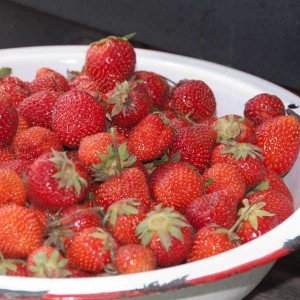
DSC_4919fbOne for me, one for the berry pan… One for me, one for the berry pan. The strawberries are coming on quickly and they are delicious. Most of the berries will be frozen so we can enjoy them throughout the year. Until they are stemmed though, the berry pan sits on the counter for anyone to partake of it’s contents. Of course the berry patch is open 24 hours a day all season for us to sate our cravings as well.

I find gardening to be a very rewarding activity and encourage readers of this blog to give it a try if you’re not already. Fair warning. Some plants, such as lettuce and spinach, are difficult to weed early on. If this frustrates you, pass on those. You might also consider starting small and increasing your garden size over time. For easier maintenance, I placed all of our permanent plants, such as berries, rhubarb and asparagus, in one area. Initial tilling of the garden for planting each new season is much easier.

Other options… Go small scale with containers. Put a tomato plant within easy reach out the back door. One year I dropped ornamental gourd seeds along a fence bordering the yard. The vines grew up the fence and I had fall decorations to share. No tilling required.

“We’ll take that one.”

About a week ago, Mason sold a bull to some folks in the Holliday area. We thought the day might end with one of our bulls being sold though. The buyers started looking at the entire group and asked if a younger one, ours, was for sell. Well, yes he was. So the three of them talked among themselves until Mason’s bull came up to sniff them. One of the buyers held out his hand and got a lick on the fingers. The buyer beside him said, “We’ll take that one.” The deal was sealed. A good disposition in an animal is a plus and we have none that are aggressive or that will run off at the first sight of us. I, personally, like to walk among the cattle once a day just to look them over. They get used to this interaction and are easy for us, and new owners, to handle.

What a productive day

What a productive day. We took action on a plan to make less work. Part of the plan is to utilize more wooded area for the cattle to graze and shelter in so today, we set t-posts through a stretch of woods and attached insulators to them. When the time comes to graze the area, we will simply string some poly wire to complete the boundary. Typically, we install some type of temporary fencing first just to make sure that the grazing patterns will flow effectively. Eventually permanent high tensile wire will be installed which means less work putting up and taking down temporary poly wire fencing and easier wooded-area maintenance.

Don’s interest in blacksmithing

For some time now, Don has had an interest in blacksmithing.  He and Mason have even made a trip to south Missouri for an overnight workshop.  It wasn’t long after returning that Don started forming the idea of making his own forge of sorts and began gathering and repurposing materials from around our farm.

DSC_4760pUsing saw horses and t-posts as a base, Don placed a sheet of roofing metal on top of it with a disk brake rotor in the center to contain the coal fire used to heat the metal being shaped.  Two inch black pipe was attached via a flange to the bottom of the rotor to channel the air to the fire and this air flow is created by an old hair dryer which has had the heating element removed.  Don even incorporated a lighting dimmer switch to control the air velocity while the dryer is on.

DSC_4768fOf course the anvils are make-shift as well.  Using a downed tree to make two waist-high support stands, Don carved out a portion in the center of each.  In one he fitted a section of road grader blade complete with a hardy hole and the other stand was fitted with a piece of railroad track.  Don continues to look for an actual anvil.

Starting off, Don has made some simple tools for campfire cooking and brackets for an improvised curtain rod.  Thanks, Honey.

Blacksmithing is an interesting craft and skill.  It brings to mind words such as durable and strong, primitive yet useful and long-lasting.  Early cultures who knew how to heat and shape iron had definite advantages over those that used stone.  Until the Industrial Revolution, blacksmiths were an intricate part of every community.  They crafted farm implements, tools, nails, barrel hoops, locks, horse shoes and hardware just to name a few items used every day.  Today, it seems to be more of an artisan avenue for making decorative ironwork.

So why did we choose these two heifers?

My only complaint about our herd bull is that he keeps producing bull calves. In the past two years, only two heifer calves have hit the ground. This scenario makes for slow replenishing within a herd so Don and I made a four hour trip to a Red Angus sanctioned sale. Before considering the trip though, we combed through the shiny sale catalog, narrowed down the prospects to nineteen and contacted the sellers with our standard questions. What type of forage are the cattle on? Have they ever had creep feed, feed supplements or grain? What type of vaccinations have they had? What is their current frame score? Are the cattle on a mineral program? Based on the answers, our prospects dropped to seven.

Don and I arrived at the sale a few hours early to get up close and personal with these girls and take a good look at them – front to back and top to bottom. Our prospects then narrowed to two bred heifers which are now doing a meet and greet across the fence from the main herd.

So why did we choose these two heifers? They have moderate frames and good dispositions. We believe they have a good glandular system and will produce adequate milk for the heifer calves they are carrying. Their body and leg structure is good. They weren’t grained to reach their current potential. And, that pretty red color is a lovely compliment to our green pastures.

WordPress theme: BryanRedAngus