Hands in the dirt

Garden planted – check.  A coworker once told me, “You just can’t wait to get your hands in the dirt”.  Its true.  I look forward to planting the garden each year.  I usually plant produce that bears a lot, such as cantaloupe.  My parents and grandparents always planted plenty to share.  That’s part of the fun of gardening.  The other fun part… sitting in the middle of the strawberry patch and flicking the stems as I eat the berries.

This year Don is trying something new.  He planted sunflowers which will support the bean plants.  Last year, some black bean and black-eyed pea vines snaked up a few sunflower stalks so Don incorporated it on purpose this year.

The idea of training bean vines up stalks isn’t new.  Native Americans planted beans, corn and squash together. It seems to be a fairly sustainable system.  Corn stalks provide a pole for the beans to climb.  Beans provide nitrogen for the corn.  Squash, of course, is also edible, and the leaves prevent moisture evaporation, shade the ground to stunt weed growth and the vines and leaves eventually become mulch.

All there is to say

My friend, Jon Angell, said all there is to say….

“By now you may have heard that the USDA has found a case of BSE in a California dairy cow. The beef supply is SAFE. Safe guards are in place to keep BSE infected cows out of the food supply and they are working… it shouldn’t be an issue. Enjoy BEEF often, I know I will!”


Looking for earthworm poo

At five o’clock Saturday afternoon I was kneeling in Dennis McDonald’s pasture looking for, and at, earthworm castings.  This was just part of a farm walk sponsored by the Green Hills Farm Project.  Interesting stuff really.  Dennis started by giving an overview of his grazing and cattle management program then he lead the group through his pastures so we could see the results.

Dennis’s pastures look super both above the surface and in the soil.  As I mentioned, we looked for earthworm activity, which there was, however he also brought out his refractometer.  The Reed canarygrass and fescue had brix readings of 21 and 11 respectively.  Twenty-one is impressive.  Don said, “You can taste the sweetness.”  Sure enough, I looked behind me and he was chewing a blade of Reed canarygrass like gum.  I can’t take him anywhere.

We moved on to the cows.  I didn’t specifically ask Dennis, however I think his herd is Red Angus and Herford cross.  These girls and their calves looked good and were very uniform in size; however what I found most interesting was their relationship to each other and their necks.  Dennis started his herd many, many years ago and held back heifers and bulls.  Every animal is related to the others in some way and Dennis raises his own bulls.  As for the cow’s necks, they had many fine wrinkles on them.  I’m a follower of Gerald Fry and Jan Bonsma and believe that those wrinkles indicate tender meat.  Someone pulled out some pH paper and tested the urine of two cows.  Both read 8.  Dennis, like everyone else, is shooting for 7.

I also found Dennis’s permaculture idea interesting.  Some of his grazing lots have no shade so he is planting Chinese chestnut trees.  Apparently these trees are ideal for Missouri’s rolling-pasture land.  The trees have been planted within the grazing layout in such a way as to provide shade and allow the cattle to graze right up next to the trees, yet not be able to rub against them or trample seedlings.  The cattle will also eat the nuts when they pop out of the burr-type shell and drop to the ground.

Of course this is just a brief overview of what was seen and discussed.  More topics included spraying milk on pastures and using a yeoman plow for improving topsoil and funneling water across pastures as opposed to letting it run into waterways.  Wild burdock was found in one of the grazing lots and some Amish folks in attendance shared about how to use it for burns and pain relief.  More interesting stuff.   I like to gather with other grazers, see their programs and hear about what they’re implementing and why.  As for Don foraging on Reed canarygrass with the cattle, I’m teasing him.  I like it when we go places together.  We each pick up on different ideas and put it all together during the ride home.  Some of the ideas we have already implemented ourselves and some are new.  One thing I plan on doing is selecting a pasture we’re trying to build up and monitor it for earthworm poo.
Fodder for the guys at the local feed and seed

The boys at the local feed and seed store chuckled at me today.  I asked if they carried crabgrass seed.  The reply, “People would give their right arm to get rid of their crabgrass.  You must be pulling my leg.”  Well, in mid-March I attended a forage conference near Linneus, Missouri.  As you might assume, all the attendees were farmers and/or ranchers.  As talk of forage management evolved, the subject of crabgrass came up and these farmers and ranchers started discussing the possibility of inter-seeding crabgrass into their pastures.  The thought was to lightly till or drag pastures in May then broadcast seed at a rate of four pounds per acre.  Graze at eight to ten inches.  Also mentioned was that crabgrass seed is pricey, however it reseeds itself if managed properly.

This discussion stuck with me so when I went to purchase some fescue and orchard grass seed, I inquired about crabgrass seed.  When the clerk realized that I was serious, he did offer to look up the availability and price.  I declined, but thanked him all the same and went out to get my purchased seed loaded.  As the dock loaders tossed the seed bags into my Cherokee, they said, “So, tell us about this crabgrass seed.”  “Well”, I said, “In mid-March…”

As I pulled away, I could just picture those feed store fellows settling back into the old, worn chairs they had left in order to assist me and start talking about the girl who came in asking about crabgrass seed.  Seed for a grass nobody wants.

The Noble Foundation and Auburn University are a few places that have done research on using crabgrass as a forage.  It sounds promising but management is key.

After returning home, I did price crabgrass seed… $325.00 per fifty pound bag.  Pricey is right.

Cowbirds are trailing the herd

The Brown-headed Cowbirds are back and trailing our small herd.  I have mixed feelings about their presence though.  Cowbirds are small blackbirds with brown heads, which walk the ground among grazing cattle, to forage on insects, beetles, spiders and seeds among other things.  They can have all the flies they want, however I covet the presence of dung beetles.  Cowbirds are known as parasites.  They lay their eggs in the nests of other birds then fly away.  The nest owner mistakenly incubates the eggs along with their own.

Well, darn it…

We received a letter from our milk supplier yesterday; he is retiring from his farm-based dairy business.  Darn it.  I can’t recall how long we’ve been buying raw milk from Sam, however it’s been awhile.  Sam is a local, honest, reliable business man, and we appreciate the service he gave us.  The fact that Sam hand wrote a full-page letter to his customers testifies to the fact that he cared about the people he served.  It has been great to have fresh milk delivered to us and we’ll miss it.  Thanks, Sam.

And homemade ice cream season is just starting too.  Double darn it.

In hindsight, we should have let the grass rest

On March 30th I mentioned drought conditions in mid-Missouri. As the summer passed by, we grazed the pastures low in an effort to hold off on feeding hay and hoped for rain that didn’t come.  We also sold a few cows.  On September 24th of last year, we started feeding hay.  We usually start feeding hay in January.  Now spring is here and we’ve had some timely rains.  Our pastures are growing and looking good, however they would be further along in growth if they had had more rest during the drought.  In hindsight, we should have let the grass rest more and fed hay earlier in one lot while the other lots rested.  What if the spring moisture hadn’t come?  When little forage is left for long amounts of time, such as drought conditions, the plant will stop growing to preserve its root energy.  If the plant’s root reserves are used up, it dies.  When this happens, there are no leaves to catch the rain when it finally does come and funnel it into the ground.  We could easily continue our own drought conditions due to a lapse in management.  Two thousand-eleven was the first year with such tough drought conditions since we implemented rotational grazing.  We’re still moving forward though, and 2012 is looking good.

Eyeballs, lips and whatever else is dropped and scraped up off the floor

“Pink slime” has made the news and false claims about it are hurting the beef industry.  It has been exaggerated to be made of discarded meat scraps which are soaked in ammonia and mixed in with meat products such as hamburger.  I like to keep in mind that reality cook shows and the media like drama and attention.  I also like to keep in mind that the USDA Food Safety and Inspections Division prohibits the use of mechanically separated beef in food for people.  None-the-less, I decided to look into this pink slime stuff.  Apparently it is lean, finely textured beef separated from fat trimmings by the use of a centrifugal force.  Sometimes, these beef trimmings are exposed to a small amount of food-grade ammonium hydroxide, in a gas form, to act as an anti-microbial agent.  Meat isn’t soaked in ammonia.  Which, really, is just common sense.  Small amounts of these trimmings are then mixed in with products such as hamburger.  Because the trimmings are so lean, the burger doesn’t have the flavor and texture that consumers are used to.  The fat in beef accounts for part of its flavor.  So, basically, pink slime, which is actually a misnomer, is lean beef.  For anyone who might stumble across this post, I hope you understand that beef is delicious, safe and nutritious.

As a side note…  Mechanically separated meat (beef) is a meat product made by forcing bones with edible meat attached through a sieve-type device to separate the bone from the meat.  This becomes dog food.

It’s official

Grazing season officially started today.  Our daughter and I set up the first lot.  I did something a little different in this area as opposed to last year.  By running an extra polywire through the a small area of our woods, I hope to extend the grazing time by a day and to trample some multifloral rose sneaking into the area.  We plan to graze most of our wooded areas this year to manage for invading cedar tree sprouts as well.

Pioneering spirit

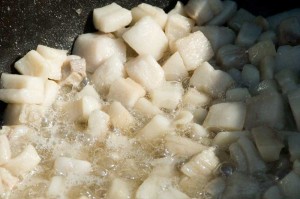
I’m not saying we’re as rugged as the homesteading families of the 1800’s, however we do have a streak of pioneering spirit running through us.  After Don started smoking a ham this morning, he lit a fire under the lard kettle and set up the press.  Time to render some lard.   It was a boiling hot chore usually reserved for the fall season, however an opportunity to get some free pork fat came our way and we just couldn’t pass it up.

WordPress theme: BryanRedAngus